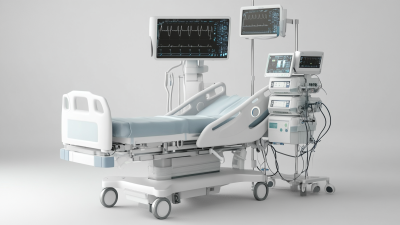
Top Hospital Equipment Manufacturers for Global Buyers

Choosing Hospital Equipment manufacturers is a practical decision with consequences long after delivery. A monitor may look suitable in a catalogue, yet its value depends on accuracy, durability, and dependable technical support. Global buyers also need to consider installation, staff training, spare parts, and local service capacity. Details matter.

This guide introduces manufacturers serving hospitals and other clinical settings. It helps buyers compare product range, manufacturing experience, quality systems, and after-sales support without treating any single feature as proof of excellence. A broad catalogue can be useful, but it does not guarantee that every model suits a facility’s needs. That distinction is easy to overlook.

Procurement teams should match equipment to intended use, available infrastructure, maintenance resources, and the skills of clinical staff. They should also verify current product specifications and relevant certifications directly with manufacturers or authorized representatives. Requirements vary by destination and product category, so a claim that applies in one market may not apply elsewhere. Check carefully.

The manufacturers discussed here can serve as starting points for research, not automatic recommendations. Buyers may need to ask difficult questions about lead times, warranty coverage, replacement parts, and service response. Some information may be difficult to compare consistently. That is worth acknowledging.

A careful assessment balances performance with long-term support and transparent documentation. The right choice is not always the most familiar brand or the lowest quoted price. It is the option that can be verified, maintained, and used reliably in the setting it is meant to serve.

Top Hospital Equipment Manufacturers for Global Buyers

How Hospital Equipment Manufacturers Are Classified by Product and Care Setting

Hospital equipment manufacturers are often classified by the products they make and the care settings those products serve. Product categories may include patient beds, monitoring systems, imaging equipment, surgical instruments, and sterilization devices. Each category faces different demands. A bedside monitor must provide readable measurements during busy shifts, while an imaging system must support consistent positioning and clear results.

Care setting offers another useful lens. Intensive care units need equipment for continuous observation and rapid adjustment. Operating rooms prioritize sterile workflows, precise controls, and reliable access to supplies. General wards often favor equipment that is easy to move, clean, and maintain. Home-care products, by contrast, must be manageable for patients and caregivers outside a clinical team. These boundaries can blur; a portable monitor may serve several settings, but its suitability still depends on training and clinical protocols.

Tips: Compare equipment by intended use, maintenance needs, staff training, and service support—not just product type. Ask how parts are replaced and how cleaning is documented. A detailed checklist helps, though real-world needs can change after installation.

Which Standards Matter: ISO 13485:2016 and IEC 60601-1

For global buyers, ISO 13485:2016 is a useful starting point for assessing a hospital equipment manufacturer’s quality management system. The standard covers controlled design, production, traceability, and corrective action. ISO’s 2022 Survey reported 32,121 valid ISO 13485 certificates across 135 countries and economies. That reach makes certification common, but it does not prove that every product is safe or suitable for a particular hospital. Check the certificate’s scope, issuing body, and current status. Ask how the supplier handles a failed inspection or a delayed corrective action. Details matter.

IEC 60601-1 addresses basic safety and essential performance for medical electrical equipment. In practical terms, buyers can ask for test evidence related to electric shock protection, temperature limits, and performance under specified conditions. Test reports should match the exact model and configuration being purchased; a similar-looking unit may differ internally. Review applicable national deviations and the manufacturer’s risk-management documentation, too. Compliance evidence is not a substitute for evaluating installation, maintenance, and staff training. A certificate can still leave questions. That is worth remembering. When procurement teams compare suppliers, they should verify documents independently and record unresolved gaps before delivery.

Key Standards for Global Medical Equipment Buyers

Publication year of the editions referenced in this comparison

ISO 13485:2016 specifies quality management system requirements for medical device organizations. IEC 60601-1 Edition 3.2, published in 2020, covers basic safety and essential performance of medical electrical equipment. Publication year alone does not indicate whether a product or manufacturer currently meets applicable requirements; buyers should verify relevant certificates, test reports, and market-specific regulations.

How to Compare Suppliers of Imaging, Monitoring, and Life-Support Equipment

Comparing suppliers of imaging, monitoring, and life-support equipment takes more than checking prices. Start with clinical fit: confirm that imaging systems meet required resolution and workflow needs, monitors display the parameters staff use, and life-support devices support the intended patient groups. OECD’s Health at a Glance 2023 reports wide differences in MRI availability across countries, underscoring that equipment access and service capacity vary by market. A supplier’s delivery promise matters less if local installation, calibration, and repair support are weak.

For each proposal, compare total ownership costs, including accessories, software, staff training, maintenance, and expected downtime. Ask for documented service response times and the availability of replacement parts in your region. Check how the supplier validates performance after installation and communicates software updates. WHO guidance on medical device management emphasizes planning across a device’s life cycle, not simply purchasing equipment. That is practical advice, though procurement teams can still overlook routine upkeep when budgets are tight.

Tips: Request a sample service record and a live workflow demonstration. Test alarms, image transfer, battery backup, and cleaning procedures with the staff who will use the equipment. Compare written warranties line by line. A polished brochure is not evidence of dependable support.

Top Hospital Equipment Manufacturers for Global Buyers - How to Compare Suppliers of Imaging, Monitoring, and Life-Support Equipment

Equipment Category Typical Clinical Use Key Technical Comparison Points Safety and Compliance Checks Service and Supply Considerations Questions for Suppliers
Ultrasound systems Diagnostic imaging using high-frequency sound waves; commonly used in abdominal, cardiac, obstetric, and vascular examinations. Transducer options; imaging modes; image quality; Doppler functions; portability; storage and connectivity features. Confirm applicable medical-device authorization in the destination market, electrical-safety documentation, and cleaning instructions for probes and accessories. Check probe availability, software support, user training, repair response times, and access to compatible consumables. Which probes and software are included? What are the warranty terms, service coverage, and expected lead times for replacement probes?
Digital radiography systems Produces X-ray images for examinations such as chest, skeletal, and abdominal imaging. Detector type and size; image workflow; generator configuration; positioning options; integration with hospital information systems. Review radiation-protection features, installation requirements, applicable equipment authorization, and local requirements for X-ray facilities. Assess detector repair or replacement arrangements, calibration support, installation services, and availability of trained technicians. What room and shielding requirements apply? How are image export, service visits, and detector replacement handled?
Computed tomography (CT) scanners Uses X-rays and computer processing to create cross-sectional images for diagnostic examinations. Detector configuration; scan and reconstruction options; patient table capacity; workflow; dose-management tools; room and power needs. Verify market-specific authorization, radiation-safety documentation, installation acceptance testing, and required facility infrastructure. Compare installation timelines, uptime commitments, planned maintenance, application training, and availability of critical spare parts. What site preparation is required? Which maintenance tasks, software updates, and applications support are covered by the service agreement?
Bedside patient monitors Displays physiological measurements such as ECG, oxygen saturation, non-invasive blood pressure, and respiratory rate, depending on configuration. Supported parameters; alarm configuration; screen readability; central-station connectivity; battery operation; data export and network compatibility. Check intended-use labeling, electrical-safety documentation, alarm behavior, and compatibility of sensors and accessories. Confirm availability of sensors, cuffs, cables, batteries, software support, and maintenance training. Which parameters and accessories are included? Can the system integrate with the existing clinical network and central monitoring workflow?
Mechanical ventilators Supports or controls breathing for patients who require respiratory assistance; suitable use depends on the device's intended setting and labeling. Available ventilation modes; patient population; oxygen and power requirements; alarm functions; monitoring features; battery and circuit options. Confirm authorized indications and patient groups in the destination market, applicable electrical-safety documentation, and instructions for cleaning and circuit replacement. Evaluate staff training, preventive maintenance, battery replacement, compatible breathing circuits, and technical support availability. For which care settings and patient groups is the unit authorized? What training, consumables, and maintenance are required?
Infusion pumps Delivers fluids or medicines at a programmed rate; pump type and intended use vary by model. Delivery modes; rate and volume settings; alarm functions; battery performance; drug-library features; compatibility with administration sets. Review intended-use labeling, accuracy specifications, electrical-safety documentation, alarm testing, and instructions for compatible sets. Check availability of approved administration sets, calibration and maintenance support, user training, and software-update processes. Which administration sets are validated for use? How are drug libraries, configuration changes, and routine performance checks managed?

Comparison guidance: Regulatory approvals, applicable standards, technical specifications, and permitted uses vary by device model and destination market. Request current model-specific documentation and verify regulatory status with the relevant national authority before purchase.

What FDA 510(k) Clearance and EU MDR Compliance Mean for Global Buyers

For global buyers, FDA 510(k) clearance and EU MDR compliance answer different questions. A 510(k) generally shows that a device is substantially equivalent to a legally marketed predicate device for its stated intended use. It is clearance, not a broad endorsement of every feature or clinical claim. Check the clearance record against the exact model, accessories, and intended use offered. Small differences matter.

Under the EU Medical Device Regulation, manufacturers must meet requirements covering safety, performance, clinical evaluation, and post-market monitoring. Depending on the device’s risk class, a notified body may assess conformity before CE marking. Ask for the EU Declaration of Conformity, applicable certificate, device classification, and current labeling. Verify that names, model numbers, and intended purposes match across documents. Paperwork can look tidy while leaving a gap.

At the receiving dock, also confirm electrical specifications, language requirements, installation needs, and local service arrangements. These details affect whether equipment can be used safely and maintained reliably. Regulatory status may differ by device variant and market, so avoid relying on a supplier’s general statement. Clearance is not performance data. Request the underlying records, then compare them with your clinical and procurement requirements. I have seen buyers focus on certificates and overlook replacement-part lead times; that deserves a second look.

How to Evaluate Service Coverage, Total Cost, and Equipment Lifecycle

Service & Support

A hospital equipment purchase is not just a delivery date and a quoted price. Ask how quickly technicians can reach your site, which parts are stocked locally, and whether support is available after hours. “We offer fast service” is not specific enough. Request response-time targets, escalation contacts, and examples of maintenance records from comparable installations. Check staff training, too: a repaired device is of little use if users cannot operate it confidently. Small details matter, such as who handles software updates and how loan equipment is arranged during repairs.

Total Cost of Ownership

Compare total cost across the equipment’s expected working life, not only the initial invoice. Include installation, user training, consumables, preventive maintenance, calibration, energy use, and eventual removal. Look closely at warranty exclusions and the price of commonly replaced parts. A spreadsheet helps, but it can still hide uncertainty. For instance, a low-cost device may require more frequent servicing, while a higher-priced model may need specialized technicians unavailable nearby. Ask suppliers to explain their assumptions and provide a service schedule. Then compare those figures with your facility’s staffing, patient volume, and maintenance capacity. The forecast will not be perfect. That is worth admitting. Revisit it when usage patterns change or service delays begin to affect clinical workflows.